Gwalior travel guide
A great hilltop fort and a royal palace, two hours south of Agra.
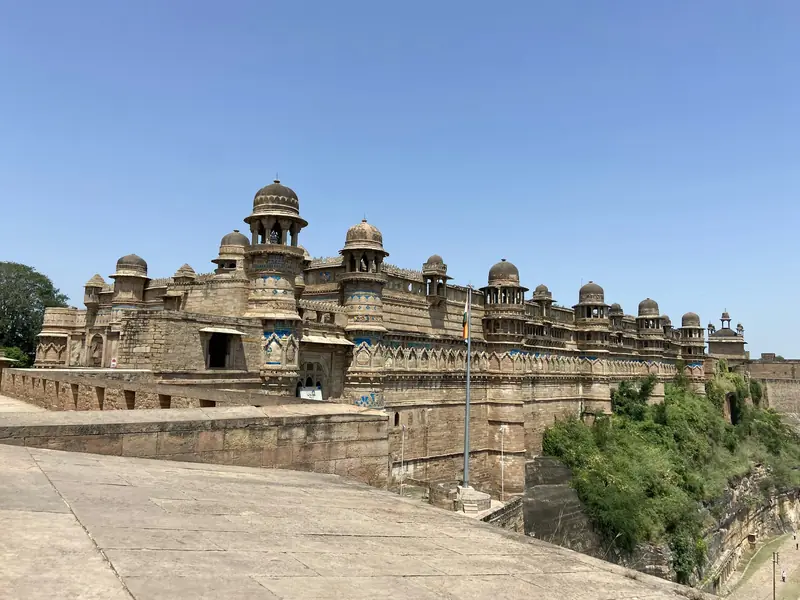
Gwalior, in the north of Madhya Pradesh, grew up around one of the most impressive forts in India, which stretches for nearly 3 km along a flat-topped sandstone hill above the city. Over the centuries it was held by Rajput, Tomar, Mughal, Maratha and British rulers, each leaving buildings behind.
The city was later the capital of the Scindia rulers, whose 19th-century Jai Vilas Palace is now partly a museum. Gwalior also has a long musical tradition: it is associated with Tansen, the singer at Akbar's court, and was named a UNESCO Creative City of Music in 2023.
Why visit Gwalior
Gwalior offers a full day of history without the crowds of Agra or Jaipur: temples from the 8th to 11th centuries, a 15th-century palace decorated with coloured tiles, Jain sculptures cut into the rock, and a royal palace full of European furniture and chandeliers. It is an easy add-on to Agra, or a stop on the way to Orchha and Khajuraho.
What to see in Gwalior
Gwalior Fort and Man Singh Palace
The fort's best-known building is the palace of Raja Man Singh Tomar, built around 1500, with its outer walls decorated in blue, green and yellow glazed tiles.
Sas-Bahu temples
A pair of 11th-century temples inside the fort, dedicated to Vishnu and covered in carving.
Teli ka Mandir
The tallest structure in the fort, an 8th- or 9th-century temple with an unusual barrel-vaulted roof.
Rock-cut Jain sculptures
Large figures of the Jain tirthankaras carved into the cliffs below the fort in the 15th century.
Jai Vilas Palace
The Scindia family's palace, completed in the 1870s, part of which is the Jiwaji Rao Scindia Museum, with a vast durbar hall and its chandeliers.
Tomb of Tansen
The tomb of the 16th-century musician, beside the larger tomb of his teacher Muhammad Ghaus. The Tansen Music Festival is held here each December.
Suggested itinerary for Gwalior
Morning
Drive or take the train from Agra, then explore the fort: Man Singh Palace, the Sas-Bahu temples and Teli ka Mandir.
Afternoon
Jai Vilas Palace and the Tomb of Tansen, then return to Agra or continue towards Orchha.
Planning your visit
How long to stay
One full day covers the main sights. Stay overnight if you are continuing to Orchha and Khajuraho, or want a slower visit.
Best time to visit
October to March. Summers are very hot, and the monsoon arrives in July. The Tansen Music Festival takes place in December.
Getting there
Gwalior is on the main Delhi–Agra–Bhopal railway line, with fast trains from Delhi and Agra. Gwalior's airport has domestic flights to a few cities.
Combine it with
Gwalior is about 120 km south of Agra, roughly two to two and a half hours by road. It is usually visited as a day trip from Agra or as the first stop on a route through Madhya Pradesh to Orchha and Khajuraho. Delhi – Agra – Gwalior works well by train.
Travel tips
- The fort is large and spread out. A car between its sights saves a lot of walking in the heat.
- Allow time for the museum at Jai Vilas Palace; it is more extensive than most visitors expect.
- Combine the fort and palace with a guide who can explain the different dynasties.
Opening hours, fees and seasonal conditions change. We confirm current details when we plan your trip.
Questions about Gwalior
Can Gwalior be visited as a day trip from Agra?
Yes. Gwalior is about two to two and a half hours from Agra by road, and fast trains are quicker. A full day is enough for the fort and Jai Vilas Palace.
Is Gwalior in Rajasthan?
No. Gwalior is in Madhya Pradesh, just south of the border with Uttar Pradesh and Rajasthan.
Plan your trip
Plan your visit to Gwalior
Tell us when you plan to travel, which places you want to explore, and what kind of experience you are looking for.
Plan My Trip- Emailindiatoursplan23@gmail.com
- Phone+91 79834 74742
- WhatsAppMessage us on WhatsApp